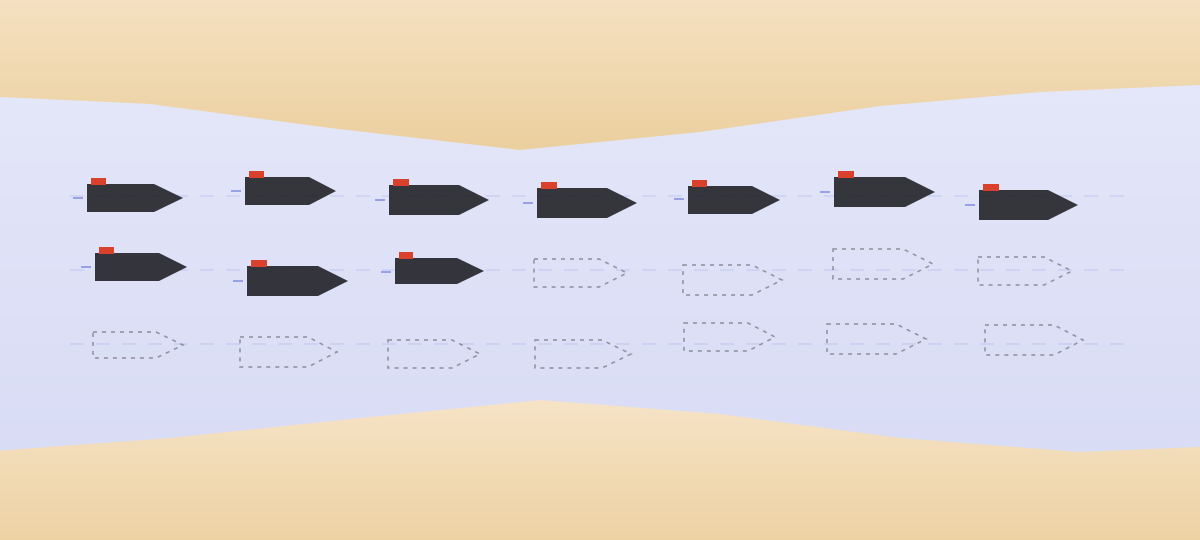
No. 03 · Oil · Strait of Hormuz
Half the oil is moving. The diesel is what’s broken.
On the government’s own numbers the strait is carrying 48% of its normal flow, not the “two-thirds or north of two-thirds” officials have described. And the reason diesel costs $6.53 is not the price of crude. It is the $2.38 a gallon now sitting between crude and the pump.
What a gallon of diesel is paying for
Dollars per gallon, US average on-highway diesel
SOURCES: EIA WEEKLY RETAIL PRICES, WEEK ENDING 21 SEPT 2026 · BRENT SPOT · BENCHMARK DIESEL CRACK SPREAD. THE MIDDLE BAND IS THE BENCHMARK CRACK, NOT ANY ONE REFINER’S REALISED MARGIN; THE THIRD BAND IS THE RESIDUAL. “A YEAR AGO” USES THE 2025 AVERAGE BRENT PRICE AND THE PRE-CONFLICT CRACK.
48%
Of normal flow through the strait, on the Energy Secretary’s own volume figure
$6.53
US average diesel, up $2.78 on the year
$2.38
Refining margin per gallon of diesel — it was $0.52 before the conflict
12%
Distillate stocks below the five-year average, while crude sits 2% above it
How it actually works
Crude oil and diesel are different markets that share a name. Crude is dug up and shipped; diesel has to be made, in a refinery, from crude — and refineries are the part of the chain with no spare capacity. US operable capacity is about 1.0 million b/d lower than it was in January 2020, and the plants that remain are running at 96.8%.
So when a war takes barrels out of the water, two things happen and only one of them is about crude. Crude rises — Brent is at $102.90, 49% above last year’s average. Diesel rises far more, because the same disruption removed roughly 1.6 million b/d of finished diesel and gasoil exports and there is nowhere to make more.
That is why every remedy being proposed — the reserve, more drilling, the bypass pipelines — is a crude remedy, and why the pump has barely noticed them.
Who absorbs it
| Who | What this costs them |
|---|---|
| Freight and agriculture Diesel is an input, not a discretionary purchase. | $2.78 a gallon more than a year ago, 74% higher, with no ability to substitute. This is the first-loss position. |
| Households | $1.30 a gallon on gasoline, 41%, plus the freight cost in everything delivered by truck. |
| Refiners | The other side of the same number: $2.38 a gallon of margin, $12.6 billion across three companies in one quarter. |
| Anyone borrowing | Diesel is an input to the price of nearly everything. It reaches the inflation prints, and the inflation prints reach the rate on a mortgage. That channel is slow, and it is the one that lasts after the headlines stop. |
SOURCES: EIA WEEKLY RETAIL PRICES · EIA WEEKLY PETROLEUM STATUS REPORT, WEEK ENDING 18 SEPT 2026 · COMPANY Q2 2026 RESULTS AS REPORTED.
The claim ledger
Six claims from the past two weeks, from both parties and from neither, each checked against a public document or a published data series. The standard is the same for all of them: what do the numbers say, and does the arithmetic hold?
- Energy Secretary Chris Wright · 13–14 September
Hormuz is running at “two-thirds or north of two-thirds of the previous flows.”
In the same remarks he gave the volume: 10 million barrels a day, averaged over the previous week. EIA puts normal flow through the strait at 21 million b/d. Ten of twenty-one is 48% — about half.
Two-thirds of normal would be 14 million b/d, 4 million more than the figure he himself supplied. The volume may well be right. The fraction built on it is not, unless “previous flows” means the worst week of the crisis rather than normal — in which case it describes a recovery from a floor, not a strait two-thirds open.
Doesn’t add up - President Trump · September
The United States is in “total control” of the strait.
Shipping counts do not support it. Reuters put pre-conflict traffic at more than 100 vessels a day. Through the week of 21 September, daily transits were running at two or fewer. Twelve commodity vessels passed over one weekend against thirty-five the weekend before.
Escorted convoys are real and Saudi loadings have recovered sharply. Control of a waterway that almost no commercial traffic will enter is a narrower claim than the words suggest, and the freight and war-risk insurance market is pricing the narrower version.
Not supported - President Trump · September
About one-fifth of the world’s oil and gas passes through Hormuz.
EIA’s published figure is 21 million b/d in 2022, about 21% of global petroleum liquids consumption, and more than a quarter of all seaborne traded oil. LNG is a similar share.
This one is right, and it is the reason the rest of the page matters. A fifth of world supply moving through a channel that two ships a day will enter is the whole story.
True - Sen. Chuck Schumer · 9 March 2026
The Strategic Petroleum Reserve “exists for moments exactly like this” — releasing would “stabilize markets, bring prices down, and stop the price shock.”
At its maximum rate the reserve can deliver 4.4 million b/d — 40% of the missing flow — for about 65 days before it is empty, and the first barrel reaches the market 13 days after the order. It holds 285 million barrels against a 714 million capacity, so it is roughly 40% full.
It is also being used already: the reserve fell from 294.1 to 285.0 million barrels between 20 August and 11 September, a rate of about 0.4 million b/d — a tenth of what the system can do.
The limit is not the argument, it is the molecule. The SPR holds crude. The shortage at the pump is distillate: stocks are 12% below the five-year average while commercial crude sits 2% above it, and US refineries are already running at 96.8% of capacity. More crude into a refining system with no spare capacity does not come out as diesel.
Partly true - Campaign line · both parties have used it
Record US oil production insulates Americans from this.
US crude production is a record — EIA forecasts 13.83 million b/d for 2026, above the 13.66 million record set in 2025. Over the same year the average gallon of gasoline rose $1.30 and diesel $2.78.
Production is not price. Crude is priced globally, and refined products more so. The US does get a discount on its own barrel — WTI is trading about $11.15 under Brent, against a few dollars in a normal year — and that discount is not reaching the pump, because what is scarce is not American crude.
EIA’s own forecast has US output rising 0.43 million b/d between 2026 and 2027. That is 4% of the flow currently missing from the strait, and it arrives over a year.
False - Circulating claim · social media and cable
Record diesel prices are price gouging by refiners.
The margin is real and it is enormous. The benchmark diesel crack spread went from about $22 a barrel before the conflict to above $100 — a record, and $2.38 of every gallon. Marathon, Valero and Phillips 66 together earned $12.6 billion in the second quarter.
But a margin that size is what a shortage looks like in a market that clears on price. US refining capacity is 1.0 million b/d lower than in January 2020, utilisation is at 96.8% with nothing held back, distillate stocks are 12% below average, and roughly 1.6 million b/d of diesel and gasoil exports have been removed from the world market.
Gouging is a claim about conduct, and nothing in the public data establishes conduct. What the data does establish is that the scarce thing is refining capacity, and that no announced policy adds any.
Not established
The arithmetic on “two-thirds”
This is the one claim on the page that can be settled without a judgement call. The Energy Secretary supplied both halves of it in the same set of remarks: 10 million barrels a day, and “two-thirds or north of two-thirds” of previous flows.
EIA’s own published baseline for the strait is 21 million b/d. The two statements are not compatible: 10 is 48% of 21, and two-thirds would be 14 million.
It matters because the fraction, not the volume, is what got quoted — and because the difference between half and two-thirds of a fifth of world supply is about 4 million barrels a day, roughly what Saudi Arabia is currently pushing through the strait in total.
Ten of twenty-one
Stated flow against the published baseline
SOURCES: EIA CHOKEPOINT ANALYSIS (2022 FLOWS, THE LATEST PUBLISHED) · SECRETARY’S REMARKS, 13–14 SEPT 2026
The menu
What each remedy can actually deliver
Million barrels a day, against a gap of 11
SOURCES: EIA CHOKEPOINT ANALYSIS · DOE SPR QUICK FACTS · EIA SHORT-TERM ENERGY OUTLOOK, 9 SEPT 2026 · EIA WEEKLY PETROLEUM STATUS REPORT
Every remedy on the table is crude, and all of them together are smaller than the gap. The bypass pipelines are the largest at 3.5 million b/d of unused capacity — and the Saudi East–West line, 5 million b/d when whole, only restarted on 22 September at reduced rate after drone damage on the 13th.
The reserve is the second largest and the most misunderstood. It can move 4.4 million b/d, which is real, for 65 days, which is not long, and it delivers crude into refineries running at 96.8%.
Nothing here adds distillate. The only things that would are a refinery restart, demand falling, or the strait reopening — and Iran has attached a price to the third: officials have said flows could resume within seven days if the US lifts its blockade of Iranian ports.
Reading one: the worst is behind us
Brent fell five sessions running into 23 September. Saudi exports through the strait went from 0.7 million b/d in August to 2.9 million b/d in the six days to 18 September. The East–West pipeline is loading again. Iran is talking, and EIA’s forecast has Brent averaging $74 next year against $91 this one. On this reading the spike is a war premium that unwinds.
Reading two: the physical market disagrees
The forward curve is still pricing scarcity now and relief later: Brent’s first-to-twelfth-month spread is $18.46, off its $29 peak but historically extreme, and the exchange-for-physical premium is still $17. Transits are at two a day. The EIA forecast above was published on 9 September — four days before the pipeline was hit — and already has gasoline averaging $3.84 this year against the $4.48 on the board now.
Unknowns register
| Unknown | Would be resolved by |
|---|---|
| The actual flow through the strait 10 million b/d is an official statement, not a published series. No government has released the underlying tanker-tracking data. | EIA or DOE publishing the series |
| How much of that flow is rerouted Barrels moving by pipeline to Yanbu or Fujairah are not barrels through the strait, and the 10 million figure does not say which is which. | Loading data by terminal |
| The baseline itself EIA’s 21 million b/d is a 2022 figure — the most recent it has published. | An updated EIA chokepoint release |
| Realised refining margins The benchmark crack is public. What each refiner actually captured, after its own crude cost and contracts, is not. | Q3 2026 company filings |
| When the East–West pipeline is whole It restarted 22 September at reduced rate. Full throughput is 5 million b/d. | Aramco or Saudi government statement |
| Whether Iran’s seven-day offer is real Conditioned on the US lifting its port blockade. Neither the offer nor the condition has been tested. | Events |
The question to ask anyone proposing a fix
Which barrel does your plan add — crude, or diesel? And on what date does it reach a pump?
Every remedy currently on the table answers “crude”, and the honest answer on timing is measured in weeks at best. The shortage that is setting the price is distillate, and nothing proposed so far makes any.
SOURCES: EIA WEEKLY RETAIL GASOLINE AND DIESEL PRICES, WEEK ENDING 21 SEPT 2026 · EIA WEEKLY PETROLEUM STATUS REPORT, WEEK ENDING 18 SEPT 2026 · EIA, THE STRAIT OF HORMUZ AS A TRANSIT CHOKEPOINT · EIA SHORT-TERM ENERGY OUTLOOK, 9 SEPT 2026 · US DEPARTMENT OF ENERGY, SPR QUICK FACTS · EIA, US ON TRACK FOR RECORD CRUDE PRODUCTION IN 2026 · AL JAZEERA, 14 SEPT 2026 (SECRETARY’S REMARKS AND REUTERS TRANSIT COUNTS) · WORLD OIL, 21 SEPT 2026 · OILPRICE, 21 SEPT 2026 · BUSINESS STANDARD, 23 SEPT 2026 (CURVE AND EFP) · FORBES, 20 SEPT 2026 (CRACK SPREADS AND REFINING CAPACITY) · SENATE DEMOCRATIC LEADERSHIP, 9 MARCH 2026
EVERY FIGURE ON THIS PAGE IS COMPUTED BY hormuz_model.py, PUBLISHED ALONGSIDE. SOURCED INPUTS AND ASSUMPTIONS ARE SEPARATED AND LABELLED IN THE FILE. NO. 03 IS A DRAFT.